
What Determines the Quality of Rendered Animal Fat
Rendered animal fat quality depends on how well your line controls five variables from start to storage: raw material condition, moisture removal, separation efficiency, filtration performance, and temperature-time exposure. Quality is not a lab value you fix at the end. You either protect fat quality through the process, or you create defects that follow the product into storage.
This page focuses on practical, equipment-linked factors you can control in an industrial rendering line.
Quality indicators buyers usually care about
Most industrial buyers judge rendered fat by whether it stays stable, ships cleanly, and behaves predictably in downstream use. Common checks include:
- Moisture level
- Insoluble solids content
- Free fatty acids trend over storage
- Odor profile and color consistency
- Flow behavior at handling temperature
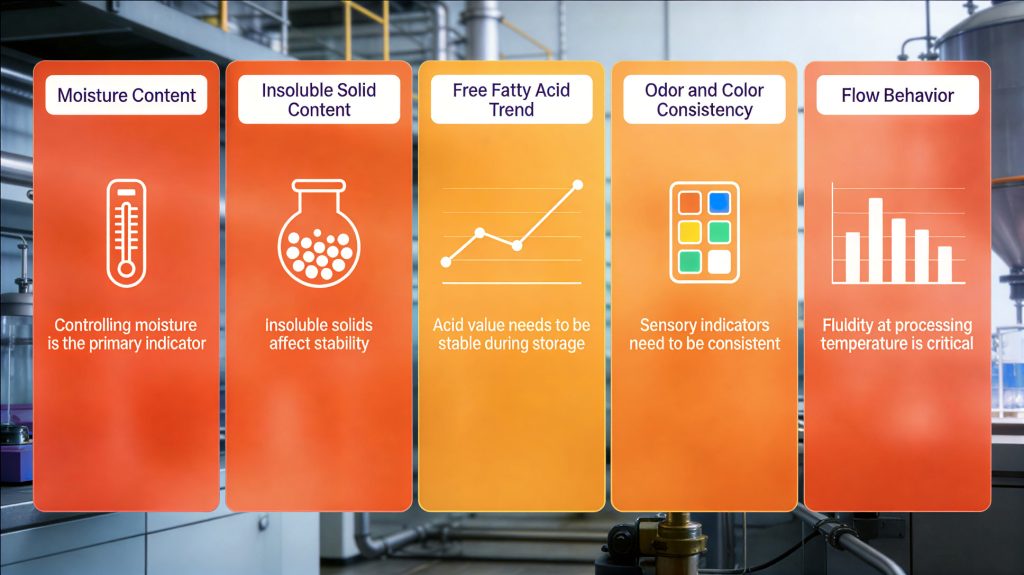
You do not need to chase every metric. In most plants, the best improvement comes from controlling moisture and solids first, then reducing unnecessary heat exposure.
Raw material condition before cooking
Freshness and contamination load
Raw material that sits too long or carries excessive water and impurities pushes your line into unstable separation and higher degradation risk. Control starts before the cooker:
- Use Material Bin / Raw Material Bin and Buffer Bin to manage feed consistency
- Use Metal Detector to reduce damage and avoid contamination events that create solids carryover
Particle size and pre-processing
Over-sized pieces heat unevenly and trap water. Over-fine grinding can increase emulsification and slow separation.
- Use Pre-Crusher / Prebreaker or Double Shaft Crusher to achieve consistent size without over-grinding
- Keep conveying stable with Screw Conveyor / Conveyor Screw
Moisture removal is the first quality gate
Moisture is the fastest way to lose fat stability. If water remains in the fat phase or keeps cycling through the system, you increase hydrolysis risk and create filtration and storage problems.
Where moisture control happens:
- Continuous Cooker or Batch Cooker Rendering drives dehydration
- Evaporation Concentration System and condensation capacity stabilize vapor handling
- Shell And Tube Condenser or Air Cooled Condenser keeps vapor removal consistent
- Vacuum Pump Unit improves low-temperature evaporation control when the process requires it
What you see when moisture control is weak:
- Cloudy fat after separation
- Rapid filter clogging
- Tank bottoms with heavy watery sludge
- Quality drift during storage and shipment
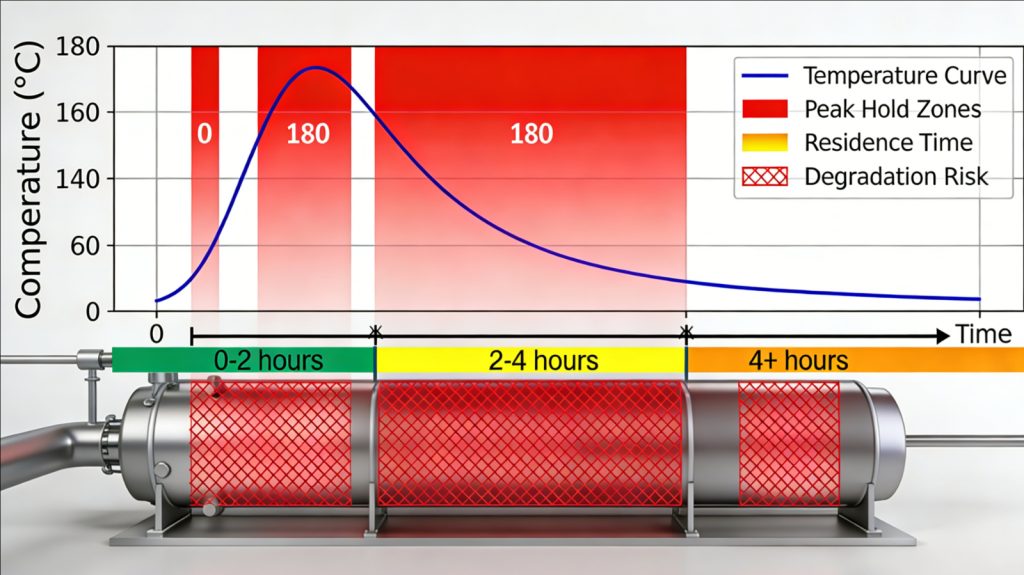
Temperature and time exposure set degradation risk
Fat quality drops when the process applies more heat than necessary for melting and water removal, or when hot fat sits too long in heated zones.
Practical controls:
- Set a stable cook end-point and avoid long peak holds
- Prevent localized overheating by maintaining mixing and heat-transfer cleanliness
- Reduce unnecessary residence time in heated fat tanks
Equipment touchpoints:
- Continuous Cooker / Batch Cooker for controlled heating profile
- Oil Tank / Oil Storage Tank for stable holding with controlled heat input
- Shell And Tube Condenser / Air Cooled Condenser to prevent vapor-handling swings that destabilize cooking behavior
Separation efficiency decides how clean the fat phase is
Even when cooking is correct, separation determines whether fat leaves the line clean or carries solids and water forward.
Key separation steps you control:
- Stable discharge from cooker to press
- Consistent press feed condition
- Clean phase split before filtration
Equipment touchpoints:
- Fat Screw Press / Fat Press or Twin Screw Press for primary separation
- Lamella Pump / Material Pump and Tallow Pump / Fat Pump for stable transfer without aeration spikes
Common separation problems and what they usually mean:
- Fat contains fine solids → press feed inconsistency, screen wear, or under-dehydration
- Fat contains water haze → dehydration incomplete or vapor handling unstable
- Yield drops while fat looks dirty → separation efficiency falling before filtration
Filtration quality determines final cleanliness and storage behavior
Filtration is where you lock in low insolubles. It is also where many plants accidentally damage fat by running too hot or by pushing unstable feed through the filter.
Equipment touchpoints:
- Fat Filtrator for final solids removal
- Stable feed delivery using Tallow Pump / Fat Pump
- Controlled temperature via appropriate tank and line heating practices
What improves filtration outcomes:
- Feed the filtrator with stable, low-water fat
- Avoid temperature swings that change viscosity and destabilize flow
- Prevent air entrainment during pumping and transfers
Storage and transfer practices can undo good processing
Even good fat leaves the filtrator vulnerable if storage creates water pickup, sediment disturbance, or repeated heating cycles.
Equipment touchpoints:
- Oil Storage Tank design and operating practice
- Pumping and recirculation strategy using Tallow Pump / Fat Pump
- Settling and clean-out discipline to prevent sludge re-suspension
Symptoms of storage-driven quality loss:
- Increasing bottom sediment volume over time
- Odor changes after transport
- Quality drift between production day and delivery day
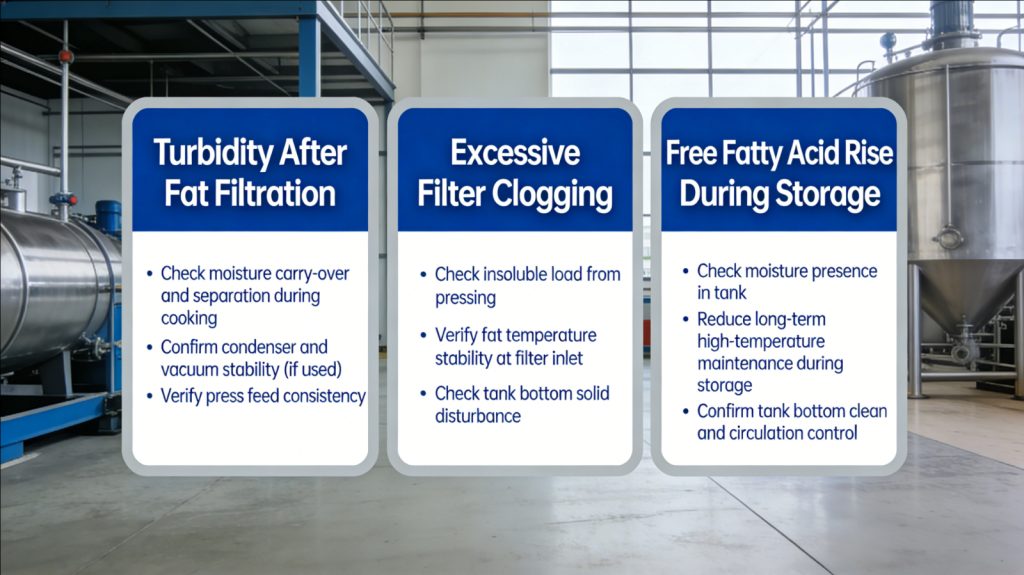
Troubleshooting map
If fat looks cloudy after filtration
- Check for moisture carryover from cooking and separation
- Confirm condenser and vacuum stability if used
- Verify press feed consistency
If filters clog too fast
- Check insolubles load coming from the press
- Verify fat temperature stability at filtrator inlet
- Check for solids disturbance from tank bottoms
If free fatty acids trend upward during storage
- Check water presence in tanks
- Reduce long hot holds in storage
- Confirm clean tank bottoms and controlled recirculation
Conclusion
Rendered animal fat quality comes from controlling moisture and solids while limiting unnecessary heat exposure. When you stabilize cooking, keep vapor handling consistent through condensation, maintain separation performance, and finish with reliable filtration, you produce fat that stays clean in storage and behaves predictably in downstream use.